
Post
Best Badminton Shuttlecock Launchers for Training
May
Automate Your Repetition Training
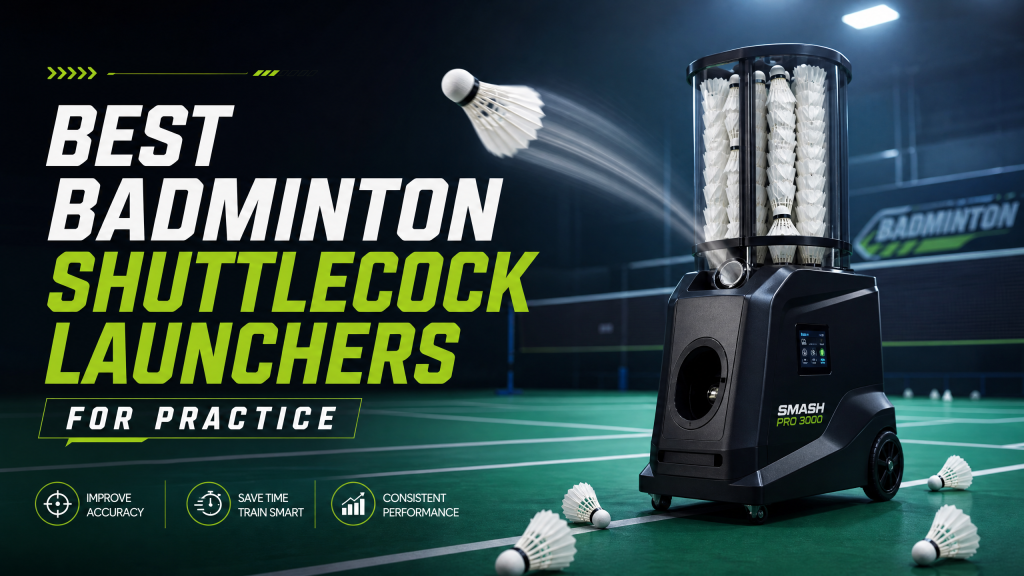
Consistency is one of the hardest parts of badminton training. Practicing a smash once or twice is easy, but repeating the same movement hundreds of times with proper timing and footwork is what develops real improvement. That is where shuttlecock launchers — also called badminton feeders or robots — become extremely valuable.
A shuttle launcher can feed dozens or even hundreds of shuttles at controlled speeds, intervals, and angles. Instead of relying on a training partner to hand-feed continuously, players can train alone while focusing entirely on technique, movement, and repetition. From beginners learning clears to advanced athletes practicing jump smashes, launchers create structured, repeatable drills that are difficult to achieve manually.
However, badminton robots are not cheap, and not every player needs one. Some machines are basic and portable, while others are sophisticated programmable systems used by national teams. This guide explains the important features, compares launcher categories, and shows how to use them effectively without wasting money or risking injury.
Why Shuttle Launchers Are Popular
Traditional badminton practice depends heavily on partners or coaches. That works well, but human feeding has limitations. Feed quality changes as the feeder becomes tired, and repetition is rarely perfectly consistent.
A launcher solves this problem by providing:
- Consistent feed speed
- Repeatable trajectories
- Adjustable intervals
- Solo practice opportunities
- High-volume repetition
This is especially useful for:
- Smash training
- Defensive drills
- Footwork repetition
- Net kill practice
- Return-of-serve training
- Multi-shuttle endurance sessions
Many players improve faster because they can focus on one skill repeatedly without interruptions.
Key Features to Consider
Not all badminton launchers are equally capable. Before buying or renting one, understand the features that matter most.
Shuttle Capacity
Capacity determines how many shuttles the machine can hold before reloading.
Typical ranges:
- Entry-level: 20–40 shuttles
- Mid-range: 60–100 shuttles
- Professional: 150–200+ shuttles
Higher capacity means longer uninterrupted sessions, which is useful for conditioning drills.
Launch Speed
Feed speed usually ranges from:
- 10 km/h for beginner lobs
- 40–60 km/h for standard drills
- 80+ km/h for advanced smash defense
Fast feeds are excellent for reaction training but can overwhelm beginners.
Trajectory Adjustment
Better machines can simulate:
- High clears
- Flat drives
- Net shots
- Pushes
- Smashes
Trajectory control dramatically increases training variety.
Feed Frequency
Feed interval affects training intensity.
Typical settings:
- Every 1 second for high-intensity drills
- Every 3–5 seconds for technical practice
- Longer intervals for beginners
Fast feeding builds endurance quickly but also increases fatigue risk.
Oscillation
Oscillation allows the machine to change direction automatically.
Options include:
- Fixed-point feeding
- Two-point alternation
- Random oscillation
Random feeding is closest to real gameplay because players must react and move unpredictably.
Power Source
Battery Powered
- Portable
- Good for temporary setups
- Limited runtime
AC Powered
- Stronger motors
- Better for clubs
- Requires nearby power outlet
Battery models are convenient for casual users, while clubs often prefer AC systems.
Entry-Level Launchers ($200–400)
Entry-level machines focus on simplicity and affordability.
Siboasi Smart Badminton Machine
One of the most common beginner launchers.
Features:
- Holds around 40 shuttles
- Adjustable speed
- Portable battery
- Basic trajectory adjustment
Strengths:
- Affordable
- Easy setup
- Lightweight
Weaknesses:
- Limited oscillation
- Frequent reloading
- Durability concerns after heavy use
Best for:
- Beginners
- Home practice
- Casual club players
Elitesport Badminton Feeder
Very similar to the Siboasi.
Good for:
- Basic repetition drills
- Serve returns
- Junior training
Not ideal for advanced multi-direction movement drills.
Mid-Range Launchers ($400–800)
This category offers the best balance between price and performance.
SuperMatch R1
A highly popular club-level launcher.
Features:
- 80-shuttle capacity
- Programmable drills
- Oscillation
- Remote control
- Speeds up to 70 km/h
Advantages:
- Excellent value
- Good movement simulation
- Suitable for serious training
Disadvantages:
- Bulkier
- More expensive batteries
This is often the “sweet spot” for dedicated players.
ProCourt Feeder Pro
Designed more for club environments.
Strengths:
- Strong feeding consistency
- Reliable motors
- Better durability
Weakness:
- AC power only
Good for coaching sessions and structured drills.
Professional Launchers ($800–1500+)
These are elite-level systems designed for high-performance athletes.
Royal Master RM-6000
Widely used by advanced clubs and training academies.
Features:
- 200-shuttle capacity
- Fully programmable drills
- Random oscillation
- Extreme speed settings
- Smartphone integration
Advantages:
- Highly realistic feeds
- Advanced customization
- Excellent for tactical drills
Disadvantages:
- Expensive
- Heavy
- Overkill for casual players
How to Use a Launcher Properly
A launcher is only effective if used intelligently.
Focus on One Skill at a Time
Examples:
- 50 forehand clears
- 30 smash repetitions
- 40 net kills
- Defensive drive returns
Avoid random hitting without a clear purpose.
Use Proper Footwork
Many players stand still and only swing.
That defeats the purpose.
Always:
- Recover to base position
- Split step before movement
- Practice realistic court patterns
Movement quality matters as much as stroke quality.
Limit Repetition Volume
Launchers encourage excessive repetition, which increases overuse injuries.
Recommended limits:
- Around 80–100 smashes per session
- Adequate rest intervals
- Shoulder stretching afterward
Too much repetitive smashing can cause:
- Rotator cuff strain
- Tennis elbow
- Wrist inflammation
Combine with Targets
Place cones or target mats on court.
Aim for:
- Back corners
- Midcourt body attacks
- Net tape zones
Accuracy training makes launcher sessions more productive.
DIY Alternatives
Not everyone needs an expensive robot.
Cheaper alternatives include:
- Manual feeding with a partner
- Rebound boards
- Wall drills
- DIY PVC launchers
Some players attempt to modify tennis ball machines, but badminton shuttlecocks are much lighter and harder to launch accurately.
For most recreational players, a reliable practice partner still offers the best value.
Maintenance and Safety
Launchers require regular care.
Maintenance Tips
- Clean feeding wheels
- Remove shuttle debris
- Recharge batteries properly
- Store indoors
- Inspect moving parts regularly
Using damaged feather shuttles increases jamming risk.
Safety Precautions
Never:
- Put fingers near launch wheels
- Stand directly in front during setup
- Allow children unsupervised use
Always:
- Place launcher on stable ground
- Learn emergency stop controls
- Use safe feeding speeds initially
Safety matters, especially with high-speed professional models.
Rental vs. Purchase
Buying makes sense if:
- You train 3+ times weekly
- You coach regularly
- You split cost with teammates
Renting is smarter if:
- You train occasionally
- You only need short-term preparation
- You want to test before buying
Many clubs now offer launcher rentals by the hour or weekend.
For tournament preparation, renting a professional launcher for one intensive week can be more cost-effective than purchasing.
Are Shuttle Launchers Worth It?
For serious badminton improvement, yes — when used correctly.
A launcher cannot replace:
- Match experience
- Tactical awareness
- Coaching feedback
- Human unpredictability
But it excels at:
- Repetition
- Conditioning
- Timing
- Technical refinement
Think of a launcher as a supplement, not a complete training system.
Final Verdict
Shuttlecock launchers are powerful training tools for players who want structured repetition and solo practice opportunities. Entry-level machines are excellent for beginners developing consistency, while advanced programmable launchers help competitive athletes refine movement and tactical patterns.
Before investing, honestly assess:
- Your playing level
- Training frequency
- Budget
- Available practice space
For many players, renting first is the smartest decision. Once you understand how often you actually use the machine, purchasing becomes easier to justify.
Used properly, a launcher can dramatically improve footwork, timing, and shot consistency — especially when combined with coaching and regular match play.
