
Post
The Complete Guide to Badminton Court Dimensions and Markings
May
Understanding Badminton Court Dimensions and Layout
A badminton court may look simple at first glance, but every line, measurement, and marking serves an important purpose. Whether you are a beginner learning the rules, a coach setting up training drills, or a club organizer preparing a tournament venue, understanding official court dimensions is essential.
Knowing the court layout helps players:
- Improve tactical awareness
- Avoid service faults
- Judge shuttle placement accurately
- Understand singles vs doubles positioning
- Set up proper practice environments
Many recreational players use courts for years without fully understanding what all the lines mean. However, once you understand the dimensions and structure of the court, your movement, serving accuracy, and strategic decision-making improve significantly.
This guide explains:
- Official Badminton World Federation court measurements
- Singles and doubles dimensions
- Net specifications
- Service areas
- Lighting standards
- Surface types
- Temporary court setup
- Common misconceptions
By the end, you’ll understand exactly how a badminton court is constructed and why those measurements matter.
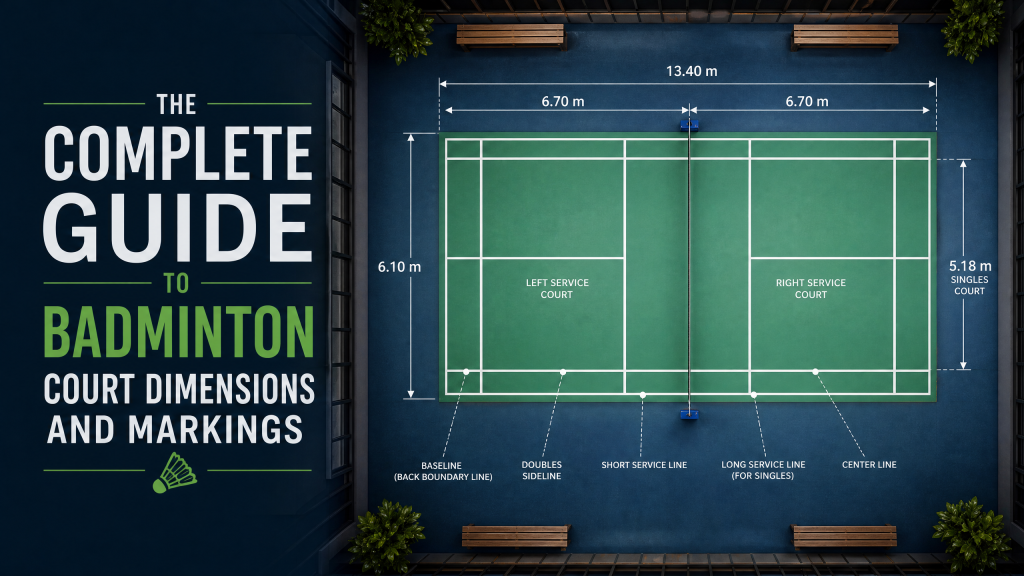
The Official Court Size
An official badminton court is rectangular.
According to Badminton World Federation regulations:
- Total court length: 13.4 meters (44 feet)
The width depends on whether singles or doubles is being played.
Doubles Court Width
- 6.1 meters (20 feet)
Singles Court Width
- 5.18 meters (17 feet)
This means singles courts are narrower than doubles courts.
Why Singles and Doubles Use Different Widths
The narrower singles court changes the tactical nature of the game.
Singles
- More movement front-to-back
- Greater endurance demand
- Longer rallies
- More precision
Doubles
- Wider defensive coverage
- Faster exchanges
- More aggressive attacking
- More emphasis on reactions
The extra width in doubles creates more attacking angles and increases pace dramatically.
Understanding the Singles Sideline
The singles sideline sits:
- 0.46 meters (1.5 feet)
inside the doubles sideline on each side.
This creates the narrow “tramline” area used only in doubles.
Many beginners accidentally aim into the doubles tramlines during singles matches, giving away points unnecessarily.
Back Boundary Line
One important detail:
- The back boundary line is the same for both singles and doubles.
However, doubles has an additional service restriction line, which causes confusion for many players.
We’ll cover that shortly.
Safety Space Around the Court
Official courts require clearance around the playing area.
Recommended minimum safety zone:
- 0.76 meters (2.5 feet)
around all sides.
Professional venues often provide even more.
This extra space allows players to:
- Lunge safely
- Recover after momentum carries them
- Avoid collisions with walls or spectators
Cramped recreational courts increase injury risk significantly.
Ceiling Height Requirements
Badminton requires substantial vertical space because of:
- High clears
- Defensive lifts
- Deep serves
Official tournament venues generally require:
- Minimum ceiling height: 9 meters (30 feet)
Recreational courts may function with:
- Around 7.5 meters (25 feet)
Low ceilings interfere with:
- Clears
- Lift practice
- Tactical shot selection
Net Specifications
The net is one of the most carefully regulated parts of the court.
Official Net Height
According to Badminton World Federation standards:
At the center:
- 1.524 meters (5 feet)
At the posts:
- 1.55 meters (5 feet 1 inch)
The net slightly dips in the middle.
This is intentional and standardized.
Net Width and Construction
The net itself measures:
- 0.76 meters (2.5 feet) deep
Mesh size:
- 15–20 mm
The top edge includes:
- 75 mm white tape
This tape improves visibility and reinforces the net structure.
Net Color and Material
Tournament nets are usually:
- Dark-colored
because dark nets provide better shuttle visibility.
The net should remain:
- Taut
- Evenly tensioned
- Properly centered
A center strap pulls the middle down to the official height.
Net Posts
An important detail many players overlook:
The posts are always positioned on:
- The doubles sidelines
even during singles matches.
Singles matches do not move the posts inward.
Some facilities use temporary singles sticks, but these are relatively uncommon outside formal competition.
Service Court Dimensions
The service courts are one of the most misunderstood parts of badminton.
Each side of the court contains:
- Left service court
- Right service court
Short Service Line
The short service line sits:
- 1.98 meters (6.5 feet)
from the net.
Serves must travel beyond this line to be legal.
If the shuttle lands before it:
- Fault
Singles Service Area
In singles:
- The serve uses the narrow singles sidelines
- The full back boundary line counts
This creates:
- Long, narrow service boxes
Doubles Service Area
Doubles service courts differ significantly.
The doubles serve:
- Uses the wider doubles sidelines
- Does NOT use the full back boundary line
Instead, doubles uses:
- A special long service line
located:
- 0.76 meters (2.5 feet)
before the back boundary.
Why Doubles Uses a Shorter Service Length
Without this rule, doubles serves would become excessively powerful and difficult to return.
The shorter service area encourages:
- Low serves
- Precision
- Faster net exchanges
Understanding All the Court Lines
A badminton court contains several important markings.
Line Width
All official lines measure:
- 40 mm (1.57 inches) wide
Usually colored:
- White
- Yellow
for visibility.
Important Rule: The Line Counts as “In”
If the shuttle touches any part of the line:
- It is considered IN.
This applies to:
- Sidelines
- Baselines
- Service lines
Even slight feather contact counts.
Center Line
The center line divides:
- Left service court
- Right service court
It runs from:
- The short service line
- Toward the back boundary
Doubles Tramlines
The outer side areas are commonly called:
- Tramlines
These are active:
- In doubles
- Not in singles
Understanding tramline positioning improves tactical shot selection.
Common Misconceptions About Court Dimensions
Many players misunderstand badminton court rules.
Misconception 1: Singles Uses Full Court Width
False.
Singles uses:
- Narrower sidelines
Only doubles uses full width.
Misconception 2: Doubles Uses Full Length for Serves
False.
Doubles serves must land before:
- The doubles long service line
not the back boundary.
Misconception 3: Shuttle Touching the Line Is Out
False.
The line counts as IN.
Misconception 4: Net Height Is Identical Everywhere
Not exactly.
The center sits slightly lower than the posts.
Setting Up a Temporary Court
Temporary badminton courts are common in:
- Schools
- Gyms
- Community centers
- Driveways
- Backyards
Essential Equipment
To create a temporary court, you need:
- Measuring tape
- Court tape
- Chalk line
- Portable net
Step-by-Step Court Setup
Step 1
Mark the net line.
Step 2
Measure:
- 6.7 meters
to each back boundary.
Step 3
Mark sidelines carefully.
Step 4
Add service lines.
Step 5
Check right angles carefully.
Incorrect angles distort court dimensions significantly.
Court Surface Types
Surface quality greatly affects:
- Grip
- Injury risk
- Speed of play
Wooden Courts
Traditional badminton halls use:
- Maple hardwood floors
Advantages:
- Excellent grip
- Natural feel
- Shock absorption
Disadvantages:
- Expensive maintenance
- Humidity sensitivity
Synthetic Courts
Modern venues often use:
- PVC
- PU
- Vinyl systems
Examples include professional badminton mats.
Advantages:
- Consistent traction
- Easier maintenance
- Tournament standardization
Surfaces to Avoid
Concrete
Too hard for joints and lunges.
Grass
Uneven bounce and unsafe footing.
Slippery Tile
Dangerous for rapid movement.
Lighting Requirements
Lighting quality strongly affects:
- Reaction time
- Shuttle visibility
- Eye fatigue
Recommended Lighting Levels
Recreational play
- Minimum 300 lux
Club-level play
- 500–750 lux
Tournament play
- 1000+ lux
Light Positioning
Lights should minimize:
- Glare
- Shadows
- Direct eye exposure
Side lighting is generally preferable to harsh overhead setups.
Recommended Color Temperature
Ideal badminton lighting uses:
- 4000K–5000K
which produces neutral white illumination.
Wheelchair Badminton Court Modifications
Wheelchair badminton uses modified court dimensions.
According to Badminton World Federation regulations:
Singles length
- 10.8 meters
Width remains largely similar.
These changes accommodate:
- Reduced wheelchair mobility
- Turning limitations
Wheelchair badminton is now an important international competitive discipline.
Why Understanding Court Dimensions Improves Your Game
Knowing the court layout improves:
- Tactical awareness
- Shot accuracy
- Serving consistency
- Positioning
- Match intelligence
Players who truly understand court geometry:
- Waste fewer shots
- Exploit open space better
- Make smarter decisions under pressure
Final Thoughts
Badminton court dimensions may seem like simple measurements, but they shape every aspect of the sport — from tactics and serving rules to movement patterns and rally structure.
Understanding:
- Singles vs doubles layouts
- Service boundaries
- Net specifications
- Surface standards
helps players compete more intelligently and train more effectively.
Whether you are:
- Setting up a backyard court
- Coaching beginners
- Joining tournaments
- Improving tactical understanding
learning official court dimensions is an essential part of mastering badminton.
