
Post
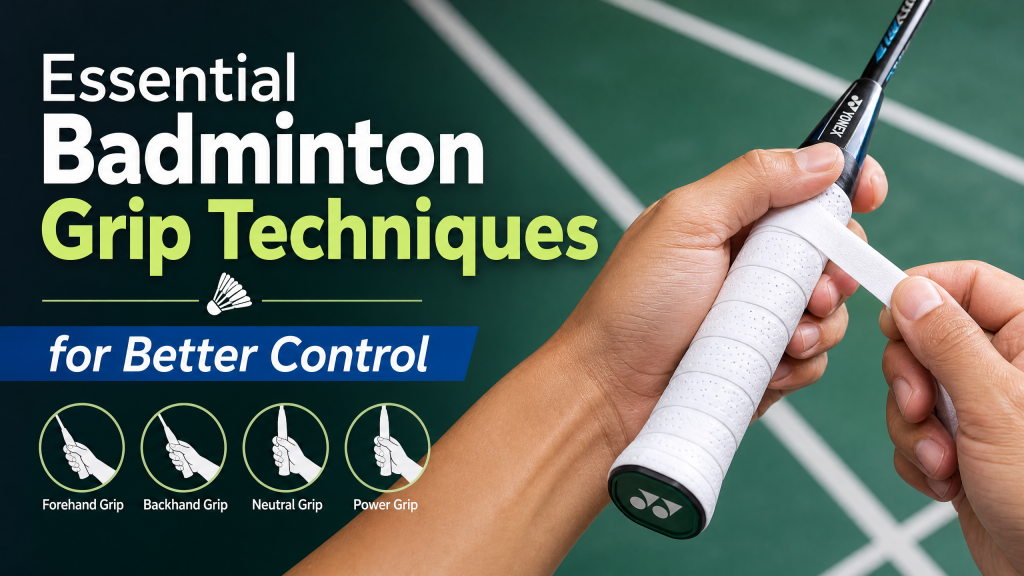
Essential Badminton Grip Techniques for Better Control
May
Mastering Badminton Grips: The Foundation of Every Great Shot
In badminton, technique begins with the grip. No matter how powerful your racket is or how fast your footwork becomes, poor grip technique limits your control, power, deception, and consistency. Many recreational players unknowingly hold the racket incorrectly for years, creating bad habits that are difficult to fix later.
A correct grip allows:
- Faster racket reactions
- Better wrist movement
- More powerful smashes
- Cleaner net shots
- Easier deception
- Reduced injury risk
Professional players constantly adjust their grip during rallies, sometimes several times within a single exchange. The ability to switch naturally between grips is one of the hidden skills that separates advanced players from beginners.
This guide explains the four essential badminton grips:
- Basic forehand grip
- Basic backhand grip
- Panhandle grip
- Bevel grip
You’ll also learn:
- Grip pressure
- Common mistakes
- Grip-changing drills
- Overgrip recommendations
- Exercises to improve hand control
Master these fundamentals and your entire game will improve.
Why Grip Technique Matters So Much
The badminton racket is designed with bevels for a reason. Unlike tennis rackets with rounded handles, badminton handles help players identify racket angles instantly through touch alone.
Correct grip technique affects:
- Shot angle
- Power generation
- Wrist pronation
- Timing
- Deception
- Recovery speed
A wrong grip often causes:
- Weak backhands
- Poor smash power
- Wrist pain
- Slow reactions
- Limited shot variety
Many players try to compensate with strength, but badminton is primarily about leverage, timing, and efficient racket mechanics.
Understanding the Handle Bevels
Before learning grips, understand the racket handle structure.
A badminton handle has:
- 8 bevels (flat surfaces)
These bevels guide hand placement.
When coaches mention:
- “Bevel 1”
- “Bevel 2”
- “Wide bevel”
- “Narrow bevel”
they are referring to these handle surfaces.
Learning to feel these bevels without looking is an important skill.
Basic Forehand Grip (“V” Grip)
The forehand grip is the most important badminton grip.
It is used for:
- Clears
- Smashes
- Drives
- Drops
- Most overhead shots
How to Hold the Forehand Grip
Imagine shaking hands with the racket.
Your:
- Thumb and index finger form a “V”
- The V aligns slightly diagonally along the wider bevel
The index finger rests slightly separated like a trigger finger.
The remaining fingers wrap naturally around the handle.
The grip should feel relaxed, not squeezed tightly.
Key Features of a Correct Forehand Grip
You should:
- See the racket edge side-on
- Feel flexibility in the wrist
- Be able to pronate naturally
The racket face should not be fully open toward the shuttle.
Common Forehand Grip Mistakes
Panhandle by Accident
Many beginners rotate the hand too far on top of the handle.
This creates a panhandle grip unintentionally.
Problems caused:
- Weak smashes
- Poor overhead angle
- Reduced pronation
- Wrist strain
Holding Too Tightly
Excessive grip pressure:
- Slows racket speed
- Reduces finger power
- Causes fatigue
The forehand grip should remain relaxed until impact.
Basic Backhand Grip (“Thumb Grip”)
The backhand grip is essential for:
- Backhand clears
- Backhand drives
- Defensive lifts
- Backhand serves
- Quick interceptions
Many beginners struggle with backhand shots simply because they use the wrong grip.
How to Form the Backhand Grip
From the forehand grip:
- Rotate the racket slightly counterclockwise (for right-handed players)
The thumb now rests flat against the wider bevel.
The thumb acts like a pushing lever.
The fingers remain relaxed.
Why the Thumb Matters
The thumb creates:
- Stability
- Leverage
- Directional control
Without proper thumb positioning:
- Backhand shots become weak
- Timing becomes inconsistent
- Wrist stress increases
Common Backhand Mistakes
Thumb Wrapped Around Handle
Instead of pressing flat, some players wrap the thumb around the grip.
This weakens leverage significantly.
Using Forehand Grip for Backhand
This is one of the most common beginner errors.
Results include:
- Weak clears
- Poor control
- Late contact points
Panhandle Grip
The panhandle grip resembles holding a frying pan.
The racket face becomes very open.
This grip is controversial because beginners overuse it incorrectly.
When Panhandle Grip Is Useful
The panhandle grip works well for:
- Quick net kills
- Fast interceptions
- Flat forecourt exchanges
- Certain emergency reactions
It allows:
- Quick contact in front of the body
When NOT to Use Panhandle
Never use panhandle grip for:
- Smashes
- Overhead clears
- Rear-court shots
Problems include:
- Loss of pronation
- Poor power
- Wrist discomfort
- Reduced reach
Advanced players only use panhandle in very specific situations.
Bevel Grip (Hybrid Grip)
The bevel grip sits between forehand and backhand.
It is especially useful in:
- Fast doubles exchanges
- Drive battles
- Net interceptions
- Defensive reactions
How to Find the Bevel Grip
Start from forehand grip.
Rotate slightly toward backhand:
- Around 20–30 degrees
The V now rests closer to a narrow bevel.
Why Advanced Players Love the Bevel Grip
The bevel grip allows:
- Faster transitions
- Compact swings
- Quick reactions
- Better deception
It is one of the most important grips for doubles specialists.
Grip Pressure: The Secret Most Players Ignore
Grip pressure is just as important as grip position.
Most recreational players grip far too tightly.
Correct Grip Pressure
At rest:
- Grip pressure should feel about 2–3 out of 10
At impact:
- Brief squeeze increases power
Immediately afterward:
- Relax again
This creates:
- Faster racket acceleration
- Better finger power
- Reduced arm tension
Why Relaxation Creates Power
A relaxed hand allows:
- Wrist snap
- Finger tightening
- Natural racket whip
Tension blocks these movements.
Professional players often appear effortless because they stay relaxed until the moment of impact.
Finger Power in Badminton
Unlike tennis, badminton relies heavily on:
- Finger squeezing
- Small grip adjustments
- Rapid hand control
The fingers generate significant racket acceleration during:
- Drives
- Pushes
- Defensive blocks
Drills to Improve Grip Switching
Drill 1: Grip Callouts
Have a partner call:
- “Forehand”
- “Backhand”
- “Bevel”
Switch instantly and shadow swing.
Do:
- 30–50 repetitions daily
Drill 2: Wall Rally
Hit alternating:
- Forehand drives
- Backhand drives
against a wall.
This naturally forces grip adjustments.
Drill 3: Shadow Footwork + Grip Change
Move around court corners while changing grips during movement.
Excellent for:
- Muscle memory
- Match realism
Grip for Different Shot Types
Smash
Mostly forehand grip with slight adjustment toward bevel for pronation.
Net Shot
Loose forehand or bevel grip for touch and spin.
Drive
Usually bevel grip for rapid reactions.
Defensive Block
Backhand or bevel grip depending on angle.
Backhand Serve
Thumb grip for precision and control.
Overgrips and Grip Feel
Overgrips affect:
- Comfort
- Sweat absorption
- Bevel feel
- Grip pressure
Thick vs Thin Grips
Thick Grips
Advantages:
- More comfort
- Larger handle feel
Disadvantages:
- Harder to feel bevels
- Slower grip changes
Thin Grips
Advantages:
- Better bevel awareness
- Faster grip transitions
- More precision
Preferred by many advanced players.
Tacky vs Dry Overgrips
Tacky Grips
Examples:
- Yonex Super Grap
Advantages:
- Excellent hold
- Less slipping
- Allows looser grip pressure
Dry Grips
Examples:
- Wilson Pro Overgrip
Advantages:
- Better for sweaty hands
- Cleaner feel
Common Grip Mistakes
Holding Too High
Some players place the hand partly on the shaft.
This reduces:
- Leverage
- Wrist movement
Always leave a small gap above the butt cap.
Moving Entire Hand During Grip Changes
Correct grip changes use:
- Finger rotation
- Small handle adjustments
not large hand repositioning.
Excessive Tension
Tight gripping creates:
- Arm fatigue
- Slower reactions
- Poor touch
Off-Court Exercises for Better Grip Control
Finger Opening/Closing Drills
Rapidly open and close fingers for endurance and control.
Grip Trainers
Devices like:
- Gripmaster
strengthen individual fingers.
Tennis Ball Squeezes
Simple and effective for:
- General hand strength
- Finger endurance
Injury Prevention Through Correct Grip
Incorrect grip mechanics contribute to:
- Tennis elbow
- Wrist pain
- Forearm tightness
- Shoulder strain
Good grip technique distributes force more efficiently and reduces stress on joints.
Final Thoughts
Grip technique is one of the fastest ways to improve your badminton level. Even players with average fitness and footwork can dramatically increase shot quality simply by correcting how they hold the racket.
Focus on:
- Relaxed grip pressure
- Smooth grip switching
- Proper thumb placement
- Finger control
Practice for just 10–15 minutes daily and the improvement becomes noticeable surprisingly quickly.
The grip truly is everything in badminton.
