
Post
How to Choose Badminton Racket Weight and Balance
May
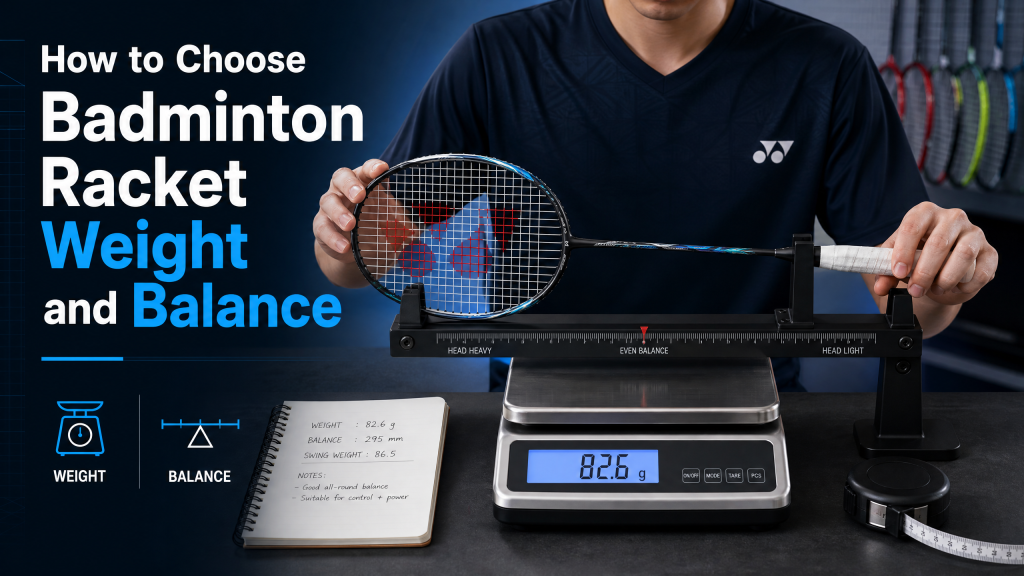
Understanding Badminton Racket Weight and Balance: How to Choose the Right Setup
When choosing a badminton racket, two specifications influence playing feel more than anything else: weight and balance. These two factors determine how fast the racket moves, how powerful your smashes feel, how quickly you defend, and even how much stress your arm experiences during long sessions.
Many players make the mistake of buying rackets based purely on professional endorsements or online hype. In reality, the best racket is the one that matches your physical strength, playing style, and technical level. Choosing the wrong combination of weight and balance can lead to poor timing, slower reactions, shoulder fatigue, or even injury.
This guide explains badminton racket weight categories, balance points, swing weight, and how to choose the right specifications for your game.
Why Weight and Balance Matter So Much
Badminton is an extremely fast sport. Every rally requires rapid reactions, explosive movement, and precise racket control.
Your racket influences:
- Swing speed
- Smash power
- Defensive reaction time
- Net play speed
- Wrist fatigue
- Shoulder stress
- Timing consistency
Even small differences of 3–5 grams or slight balance changes can dramatically alter how a racket feels during gameplay.
Understanding these specifications helps players choose equipment more intelligently instead of relying purely on marketing terms.
Understanding Badminton Weight Categories (U System)
Badminton racket weight is usually labeled using the “U” system.
Each decrease in U number means the racket becomes heavier.
Weight Classification
| Category | Weight Range |
|---|---|
| 2U | 90–94g |
| 3U | 85–89g |
| 4U | 80–84g |
| 5U | 75–79g |
| 6U | 70–74g |
These weights are usually measured before strings and grips are added.
Strings and overgrips typically add another:
- 5–7 grams total
2U Rackets: Heavy Power-Oriented Models
2U rackets were common years ago but are now relatively rare.
Characteristics:
- Maximum momentum
- Strong smash potential
- Slower defensive handling
- Increased arm fatigue
These rackets are mainly suitable for:
- Very strong players
- Traditional singles styles
- Players prioritizing raw power
For most modern club players, 2U is too demanding.
3U Rackets: Traditional Competitive Weight
3U remains popular among advanced singles players.
Advantages:
- Strong power generation
- Stable feel on impact
- Better momentum through the shuttle
Disadvantages:
- Slower reaction speed
- Higher physical demand
- More shoulder and wrist stress
Strong attacking players often prefer 3U head-heavy rackets.
4U Rackets: The Modern Standard
Today, 4U is the most common badminton racket weight.
Why?
Because it balances:
- Power
- Speed
- Maneuverability
- Comfort
4U works extremely well for:
- Intermediate players
- Doubles specialists
- All-round players
- Most recreational competitors
Many modern professional doubles players also use 4U setups.
5U and 6U Rackets: Lightweight Speed
Lightweight rackets focus heavily on speed and ease of handling.
Benefits:
- Fast defensive reactions
- Reduced arm fatigue
- Easier maneuverability
- Comfortable for juniors and seniors
Limitations:
- Less momentum on smashes
- Reduced stability on hard impacts
- Sometimes less solid feel
These weights are often ideal for:
- Juniors
- Older players
- Defensive specialists
- Players recovering from injury
Understanding Balance Point
Weight alone does not determine how heavy a racket feels.
Balance point is equally important.
Balance point measures where the racket’s mass is distributed.
It is measured in millimeters from the handle end.
Balance Point Categories
| Balance Point | Classification |
|---|---|
| 285–295mm | Head-light |
| 295–305mm | Even-balanced |
| 305–315mm | Head-heavy |
| Above 315mm | Very head-heavy |
The higher the balance point, the more mass is concentrated toward the racket head.
Head-Light Rackets
Head-light rackets move quickly through the air.
Advantages:
- Fast defense
- Quick drives
- Easier net play
- Reduced fatigue
Disadvantages:
- Less natural smash power
- Slightly reduced rear-court momentum
These rackets are excellent for:
- Doubles front-court players
- Defensive players
- Fast reaction-based styles
Examples include many models from the Yonex Nanoflare series.
Even-Balanced Rackets
Even-balanced rackets aim to provide versatility.
They offer:
- Balanced power and speed
- Good all-round performance
- Easier adaptation for most players
This category is extremely popular because it works well across:
- Singles
- Doubles
- Mixed play styles
A classic example is the Yonex Arcsaber 11.
Head-Heavy Rackets
Head-heavy rackets shift more mass toward the racket head.
Advantages:
- Increased smash power
- Stronger clears
- More momentum
Disadvantages:
- Slower defensive speed
- Greater fatigue
- Increased wrist and shoulder load
Head-heavy rackets are especially popular among attacking singles players.
Examples include:
- Yonex Astrox 88D Pro
- Yonex Astrox 99
Why Swing Weight Matters More Than Static Weight
One of the most misunderstood concepts in badminton equipment is swing weight.
Static weight only measures how heavy the racket is on a scale.
Swing weight measures how heavy the racket feels during motion.
A lighter racket with a very head-heavy balance can actually feel heavier during swings than a heavier even-balanced racket.
For example:
A 4U head-heavy racket may feel slower than a 3U even-balanced racket because more mass sits far from the hand.
This is why testing rackets personally matters so much.
Typical Swing Weight Ranges
| Swing Weight | Feel |
|---|---|
| Below 85 | Very light |
| 85–88 | Light |
| 88–91 | Medium |
| 91–94 | Heavy |
| Above 94 | Very heavy |
Most club players prefer:
- 88–91 swing weight
Advanced professionals may use:
- 92–94
Choosing Based on Playing Style
Different play styles benefit from different setups.
Singles Attacking Players
Recommended:
- 3U or 4U
- Head-heavy balance
Why?
Singles players rely heavily on:
- Rear-court pressure
- Powerful clears
- Steep smashes
Head-heavy rackets help generate stronger momentum.
Singles All-Round Players
Recommended:
- 4U
- Even-balanced
This setup offers:
- Tactical flexibility
- Balanced defense and attack
- Better stamina management
Singles Defensive Players
Recommended:
- 4U
- Head-light
Fast racket movement helps:
- Defensive retrieval
- Counterattacks
- Speed-oriented play
Doubles Front-Court Specialists
Recommended:
- 4U
- Head-light
Fast handling is critical for:
- Drive exchanges
- Net interceptions
- Quick reactions
Heavy head rackets often feel too slow at the net.
Doubles Rear-Court Attackers
Recommended:
- 4U
- Slightly head-heavy
This setup balances:
- Smash power
- Defensive speed
- Rotation recovery
Mixed Doubles Recommendations
Typical trends:
- Male rear-court players: 3U or 4U head-heavy
- Female front-court players: 4U even-balanced or head-light
Of course, personal preference still matters.
Weight and Injury Prevention
Choosing the wrong racket can contribute to injury.
Heavy Rackets Increase Joint Stress
Heavier setups place more load on:
- Shoulders
- Elbows
- Wrists
Players with:
- Tennis elbow
- Rotator cuff pain
- Wrist strain
often benefit from lighter rackets.
Head-Heavy Setups and Wrist Fatigue
Excessively head-heavy rackets increase wrist torque during:
- Defense
- Drive exchanges
- Fast recovery shots
Some players switch to lighter setups as they age to reduce long-term strain.
How to Test Weight and Balance Properly
Never judge rackets only by specifications online.
Basic Testing Method
Hold the racket normally and perform:
- Air swings
- Defensive movements
- Smash motions
Ask yourself:
- Does it feel sluggish?
- Does it move naturally?
- Is the head too slow?
- Does it feel unstable?
Try Swinging with Eyes Closed
This surprisingly useful test helps players focus purely on:
- Momentum
- Head weight
- Swing timing
without visual distractions.
Choking Up the Grip
Holding the racket slightly higher on the handle temporarily reduces swing weight feeling.
If the racket only feels manageable when choking up significantly, it may be too demanding.
Adjusting Balance with Lead Tape
Some advanced players fine-tune rackets using lead tape.
Adding tape at:
- 12 o’clock increases head-heaviness most strongly
Even small additions can noticeably change:
- Swing feel
- Power
- Timing
However:
- Added weight increases fatigue
- Too much tape harms maneuverability
Most players should avoid adding more than:
- 5 grams total
Common Mistakes Players Make
Copying Professional Players
Professionals use heavier setups because:
- They are stronger
- They train daily
- Their technique is elite
Most recreational players should prioritize comfort and consistency instead.
Ignoring Swing Weight
Static weight alone is misleading.
Always consider:
- Balance point
- Swing feel
- Maneuverability
Choosing Too Heavy for Doubles
Many players buy head-heavy rackets for doubles and later struggle during fast exchanges.
Doubles usually rewards speed more than raw power.
Forgetting String Weight
Strings and grips significantly alter final racket feel.
A heavily strung racket may feel very different from the factory specification.
Recommended Weight and Balance Table
| Player Type | Recommended Weight | Recommended Balance |
|---|---|---|
| Beginner | 4U or 5U | Even or head-light |
| Intermediate attacking | 4U | Head-heavy |
| Intermediate defensive | 4U | Head-light |
| Advanced singles | 3U or 4U | Head-heavy |
| Doubles front-court | 4U | Head-light |
| Senior / Junior | 5U | Even-balanced |
These are guidelines rather than strict rules.
Final Thoughts
Badminton racket weight and balance dramatically affect comfort, timing, speed, power, and long-term physical health. There is no universally “best” setup — only the setup that matches your body, skill level, and playing style.
For most players, a 4U racket with even or slightly head-heavy balance provides the best combination of performance and usability. More advanced players can then fine-tune based on tactical preference and physical strength.
The most important advice is simple: test rackets personally whenever possible. Specifications only tell part of the story. The real answer comes from how the racket feels in your hand during actual play.
