
Post
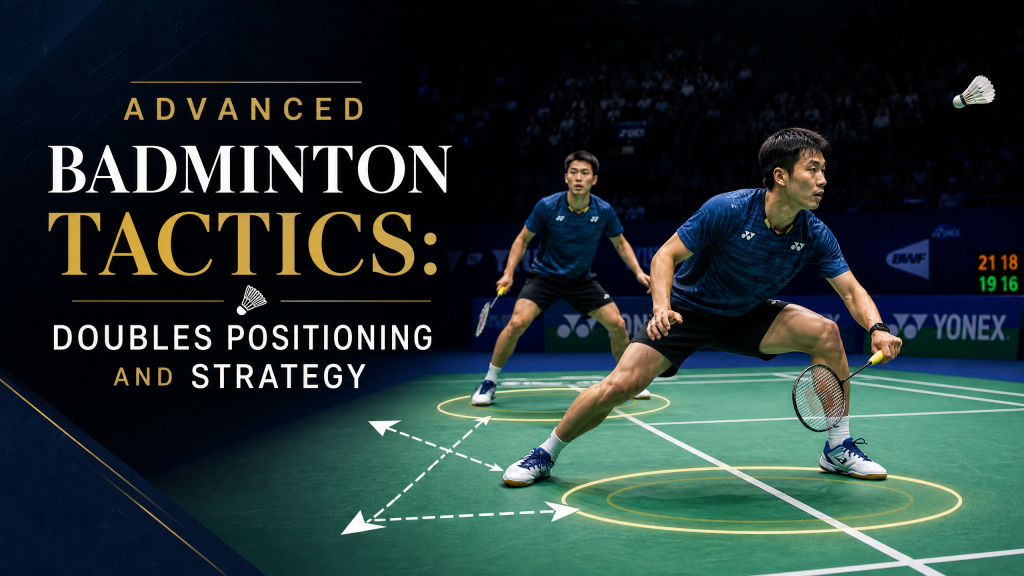
Advanced Badminton Tactics: Doubles Positioning and Strategy
May
Doubles: A Game of Angles and Partnerships
Doubles badminton is one of the fastest and most tactical racket sports in the world. Compared to singles, doubles rallies are quicker, flatter, and far more aggressive. Success is not only about individual skill — it depends heavily on teamwork, positioning, communication, and understanding court dynamics.
Many players transition from singles into doubles expecting the same strategies to work, only to discover that doubles requires a completely different mindset. In singles, patience and court coverage dominate. In doubles, speed, pressure, interceptions, and coordinated movement are everything.
This comprehensive guide explores advanced doubles tactics, including formations, rotations, shot selection, defense, communication, and training drills. Whether you play men’s doubles, women’s doubles, or mixed doubles, these principles will help elevate your game.
Understanding the Nature of Doubles Badminton
Doubles badminton is built around creating and exploiting angles. Because two players share the court, movement patterns become more compact, and rallies often revolve around maintaining attacking pressure.
Key characteristics of doubles include:
- Faster rally pace
- More flat exchanges
- Greater emphasis on attacking
- Shorter reaction times
- Tactical positioning
- Continuous partner coordination
Unlike singles, lifting the shuttle repeatedly in doubles is dangerous because opponents can attack aggressively. The pair that controls the attack usually controls the rally.
The Two Core Formations
At the heart of doubles strategy are two essential formations:
Attack Formation: Front and Back
This is the standard attacking setup.
Positioning
- One player stands near the rear court
- One player stands near the front court
Responsibilities
Rear Player
- Smash
- Clear
- Play steep drops
- Maintain attacking pressure
Front Player
- Intercept weak returns
- Kill loose net shots
- Pressure opponents at the net
The front player is extremely important. Even if they touch the shuttle less often, their positioning forces opponents into errors and weak lifts.
Why It Works
The front-back system covers both vertical court dimensions:
- Rear player controls depth
- Front player controls the net
This allows continuous attacking pressure.
Defense Formation: Side-by-Side
When under attack, doubles teams shift into a defensive shape.
Positioning
- Both players stand parallel
- Each covers half the court
Responsibilities
- Defend smashes
- Return drives
- Block attacks
- Wait for opportunity to regain attack
Key Defensive Principle
Stay low with:
- Bent knees
- Racket up
- Weight on front of feet
Good defense is not passive survival. Strong defensive pairs can transform defense into attack within one shot.
Rotations and Movement
One of the biggest differences between beginner and advanced doubles pairs is rotational movement.
Strong doubles teams rotate smoothly and naturally during rallies.
Example Rotation
- Rear player smashes
- Opponent blocks weakly
- Rear player moves forward
- Front player rotates backward
This constant adjustment prevents open spaces.
Common Rotation Errors
- Both players moving forward simultaneously
- Nobody covering rear court
- Standing still after shots
- Delayed recovery
Advanced pairs appear synchronized because they anticipate each other’s movement instinctively.
Shot Selection in Doubles
Shot selection in doubles is very different from singles.
Keep the Shuttle Down
This is the golden rule.
Preferred shots include:
- Smashes
- Drives
- Flat pushes
- Fast net shots
- Stick smashes
- Half smashes
Why Flat Shots Matter
Flat rallies reduce opponents’ attacking opportunities and force quick reactions.
High lifts give opponents time to attack aggressively.
The Importance of the Body Smash
One of the most effective attacking shots in doubles is the body smash.
Why?
- Difficult to defend cleanly
- Creates confusion between partners
- Limits racket preparation
Instead of always smashing to sidelines, aim directly at:
- Right hip
- Shoulder
- Racket arm
This forces awkward defensive returns.
Using Variation
Good doubles attackers vary pace constantly.
Instead of smashing every shot:
- Mix in half smashes
- Use slice drops
- Change direction
- Attack cross-court occasionally
Variation disrupts defensive rhythm.
Defensive Strategies Against Smashes
Every doubles player must learn effective smash defense.
Proper Defensive Position
- Stand side-by-side
- Stay about 2 meters behind service line
- Keep racket high
- Bend knees deeply
Defensive Return Options
Flat Drive
Fastest way to counterattack.
Soft Block
Drops shuttle near net and forces opponents forward.
Push to Rear Court
Targets weak backhand corners.
Avoid lifting unless absolutely necessary.
Net Play and Interceptions
The front court player is often the “hunter” in doubles.
Their job is to:
- Intercept weak returns
- Force pressure
- Finish rallies quickly
Net Kills
A net kill is a steep downward interception near the net.
Keys:
- Stay alert
- Keep racket high
- Move aggressively forward
Fast reactions at the net can decide entire matches.
Spinning Net Shots
Tumbling net shots create:
- Weak lifts
- Hesitation
- Uncomfortable returns
Good net technique combines:
- Soft fingers
- Relaxed grip
- Precise timing
Serving and Receiving Tactics
In doubles, serving becomes highly tactical.
Low Serve
The standard doubles serve is:
- Short
- Tight
- Flat
- Just over the net
A high serve in doubles is dangerous because opponents can smash immediately.
Serve Variations
Good servers vary placement:
- Wide serve
- T serve
- Body serve
Variation prevents receivers from anticipating.
Aggressive Receiving
Receivers should stand close to the service line and attack immediately.
Common attacking returns:
- Push to sidelines
- Fast drive
- Net kill
- Flat return
Passive returns allow servers to take control.
Communication Between Partners
Great doubles pairs communicate constantly.
Verbal Communication
Simple commands:
- “Mine”
- “Yours”
- “Leave”
- “Switch”
Short, clear calls reduce confusion.
Hand Signals
Before serving, many advanced pairs use hidden signals behind the back.
Examples:
- Thumb = wide serve
- Fist = body serve
- Open hand = T serve
Signals help coordinate third-shot tactics.
Mixed Doubles Strategy
Mixed doubles introduces unique tactical dynamics.
Traditionally:
- Male player controls rear court
- Female player controls front court
However, modern mixed doubles is becoming more flexible.
Front Court Importance
The female front-court player often controls:
- Net pressure
- Interceptions
- Rally tempo
Strong mixed doubles teams rely heavily on aggressive net play.
Identifying Opponent Weaknesses
Advanced doubles is about targeting weaknesses systematically.
Common Weaknesses
Weak Backhand
Attack rear backhand corner repeatedly.
Slow Footwork
Increase pace with flat drives.
Poor Net Play
Force tight net exchanges.
Weak Defense
Smash continuously at body.
Strong doubles teams analyze opponents during rallies and adapt quickly.
Physical Conditioning for Doubles
Doubles requires explosive athleticism.
Important physical qualities:
- Fast reactions
- Wrist strength
- Shoulder endurance
- Lateral movement
- Core stability
Recommended Conditioning
Sprint Intervals
5-10 meter explosive sprints.
Agility Training
Cone drills and ladders.
Reaction Drills
Light systems or partner-fed drills.
Strength Training
Focus on:
- Legs
- Core
- Rotational power
- Forearms
Unlike singles, doubles relies more on repeated explosive movements than long endurance.
Effective Doubles Practice Drills
Smash and Defense Drill
- One side attacks continuously
- Other side defends
- Rotate every few minutes
Improves:
- Defensive reflexes
- Attack consistency
Rotation Drill
Coach feeds shuttles randomly while pair rotates continuously.
Develops:
- Movement synchronization
- Court awareness
Serve and Return Practice
Practice:
- Low serves
- Aggressive returns
- Third-shot attacks
Many doubles rallies are decided within first 3 shots.
Flat Drive Exchanges
Stand midcourt and exchange continuous drives.
Improves:
- Reaction speed
- Racket preparation
- Wrist control
Common Doubles Mistakes
Lifting Too Much
Beginners give away attack too easily.
Standing Too Upright
Low stance improves reactions.
Poor Communication
Silence creates confusion.
Overlapping Coverage
Both players chasing same shuttle leaves open court.
Smashing Without Purpose
Power alone is not enough — placement matters more.
Mental Aspects of Doubles
Doubles requires trust and chemistry.
Good partnerships develop:
- Confidence
- Predictability
- Tactical understanding
Avoid blaming partners after mistakes. Strong communication and positive energy improve performance dramatically.
The best doubles teams think as a unit rather than two individuals.
Final Thoughts
Doubles badminton is a thrilling combination of speed, teamwork, and tactical intelligence. While powerful smashes and fast reactions are important, true success comes from:
- Smart positioning
- Smooth rotation
- Aggressive net play
- Clear communication
- Consistent teamwork
Mastering doubles takes time because it involves understanding not only your own movement, but also your partner’s positioning and intentions.
Start by practicing the basics:
- Front-back attack
- Side-by-side defense
- Low serves
- Flat drives
- Communication
As your coordination improves, rallies will become faster, smoother, and far more strategic.
Most importantly, find a regular partner and build chemistry together. In doubles badminton, great partnerships often defeat individually stronger players.
