
Post
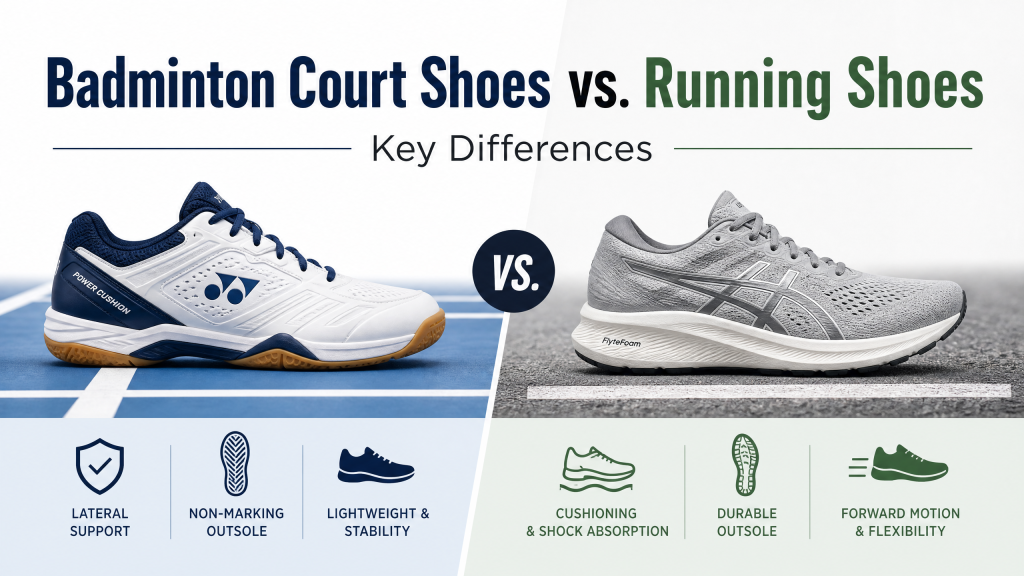
Badminton Court Shoes vs. Running Shoes: Key Differences
May
Can You Use Running Shoes for Badminton? Why Proper Court Shoes Matter
Many beginners enter badminton wearing whatever athletic shoes they already own, and in most cases, that means running shoes. At first glance, this seems reasonable. Running shoes are comfortable, lightweight, and designed for sports activity. However, badminton places completely different demands on the body compared to running.
The short answer is simple: running shoes are not suitable for badminton.
Badminton involves explosive lateral movement, rapid direction changes, lunges, jumps, and sudden stops. Running shoes are designed primarily for forward motion over long distances. Because of these biomechanical differences, using running shoes for badminton can increase injury risk, reduce movement efficiency, damage indoor courts, and wear out the shoes extremely quickly.
This guide explains exactly why badminton players should use dedicated court shoes and what features matter most when choosing the right pair.
Why Running Shoes Are Not Designed for Badminton
Running shoes are engineered for repetitive forward movement. Their primary purpose is to absorb impact during heel strikes while helping runners move efficiently in a straight line.
Badminton movement is completely different.
A typical badminton rally involves:
- Side-to-side shuffling
- Explosive lunges
- Quick pivots
- Backward recovery steps
- Sudden deceleration
- Vertical jumping
These movements place heavy stress on ankles, knees, and the forefoot from multiple directions. Running shoes simply are not built to handle these forces safely.
Outsole Design: The Biggest Difference
One of the most important differences between running shoes and badminton shoes is the outsole.
Running Shoe Outsoles
Running shoes usually feature:
- Thick tread patterns
- Outdoor rubber compounds
- Forward traction design
- Foam-heavy construction
These outsoles are optimized for:
- Asphalt
- Concrete
- Outdoor tracks
- Trails
On indoor badminton courts, they often become slippery and unstable.
Badminton Shoe Outsoles
Badminton shoes use:
- Non-marking gum rubber
- Herringbone or hexagonal tread patterns
- Multi-directional grip systems
These features maximize traction during:
- Lateral pushes
- Lunges
- Sudden stops
- Fast directional changes
The gum rubber also protects indoor wooden courts from damage.
If you wear running shoes on a badminton court, you may:
- Slide during lunges
- Lose traction during recovery
- Damage court flooring
- Wear down the outsole quickly
Cushioning and Midsole Stability
Cushioning systems are another major difference.
Running Shoes Prioritize Soft Cushioning
Modern running shoes often use thick EVA or foam midsoles designed to absorb repeated heel impact over long distances.
These shoes commonly feature:
- High stack height
- Soft foam compression
- Elevated heel design
- Large heel-to-toe drop (8–12mm)
While comfortable for running, this setup becomes unstable during badminton movements.
Why Thick Cushioning Is Dangerous for Badminton
Badminton players constantly shift weight laterally. Thick foam creates instability during side movement and increases the chance of ankle rolling.
This is why badminton shoes use:
- Lower-profile midsoles
- Firmer cushioning
- Reduced heel height
- Better ground contact
Most court shoes use a heel-to-toe drop around 4–6mm, which allows more natural lunging and faster recovery.
The lower center of gravity improves:
- Stability
- Balance
- Reaction speed
- Foot control
Upper Support and Lateral Protection
The upper structure of the shoe also matters significantly.
Running Shoe Uppers
Most running shoes prioritize:
- Lightweight mesh
- Breathability
- Flexibility
However, they provide limited side support because runners mostly move forward.
Badminton Shoe Uppers
Badminton shoes include:
- Reinforced side panels
- TPU heel stabilizers
- Strong lateral support
- Toe protection bumpers
These reinforcements prevent excessive foot movement during aggressive side cuts and lunges.
Why Toe Bumpers Matter
Badminton players frequently drag the front foot during lunges.
Court shoes include reinforced toe guards that:
- Protect the upper material
- Increase durability
- Prevent premature tearing
Running shoes lack this protection, which is why many badminton players wearing running shoes quickly develop holes near the big toe area.
Weight and Flexibility Differences
Weight distribution and flexibility also differ greatly between the two shoe categories.
Running Shoes
Many modern running shoes now exceed 300 grams due to:
- Thick cushioning
- Carbon plates
- Large foam midsoles
They are designed to flex naturally along the running stride.
Badminton Shoes
Badminton shoes usually weigh:
- Around 250–300 grams
They are designed for:
- Quick acceleration
- Fast footwork
- Multi-directional movement
Court shoes flex primarily at the forefoot for lunging while remaining torsionally rigid to resist twisting during side movement.
This torsional stability is critical for injury prevention.
Injury Risks of Using Running Shoes for Badminton
One of the biggest reasons to avoid running shoes is injury risk.
Research consistently shows that court sports require specialized footwear due to the demands of lateral movement.
Using running shoes for badminton increases the likelihood of:
- Ankle sprains
- Knee pain
- Shin splints
- Plantar fasciitis
- Achilles strain
- Forefoot pain
Lateral ankle sprains are especially common because running shoes do not provide enough side support.
The money saved by avoiding proper badminton shoes often ends up being spent on:
- Medical treatment
- Physiotherapy
- Recovery time
- Replacement shoes
Are Tennis Shoes Better Than Running Shoes?
Yes. Tennis shoes are significantly safer for badminton than running shoes because they are also designed for lateral movement.
Tennis shoes provide:
- Better side support
- More stable outsoles
- Improved court grip
However, they are not perfect for badminton.
Compared to badminton shoes, tennis shoes are usually:
- Heavier
- Stiffer
- Built for harder surfaces
- Less flexible during lunges
If you already own tennis shoes, they are acceptable for occasional badminton play, but dedicated badminton shoes remain the better option.
Can Volleyball Shoes Work for Badminton?
Volleyball shoes are actually fairly close to badminton shoes in design philosophy.
They usually include:
- Gum rubber outsoles
- Good grip
- Lateral support
- Indoor court compatibility
However, volleyball shoes often have:
- Thicker soles
- Higher cushioning
- Slightly less forefoot flexibility
They can work reasonably well, especially for recreational players, but badminton-specific shoes still offer superior movement performance.
What to Look for in Your First Badminton Shoe
When buying your first proper badminton shoe, focus on these key features:
- Non-marking gum rubber outsole
- Herringbone or hexagonal tread
- TPU heel stabilizer
- Reinforced side support
- Forefoot flex grooves
- Toe protection bumper
- Low-profile cushioning
Avoid generic “cross-training” shoes because they are designed for gym workouts rather than court sports.
Recommended Beginner Court Shoes
Several beginner-friendly badminton shoes offer excellent value and performance.
Popular options include:
- Yonex Cascade Drive
- Asics Gel-Rocket 11
- Victor P9200 TD
These models provide proper court grip, stability, and cushioning without requiring a huge investment.
Breaking In Badminton Shoes
Most badminton shoes require very little break-in time.
A proper fit should feel:
- Snug
- Stable
- Secure at the heel
- Comfortable in the forefoot
Do not intentionally buy oversized shoes to compensate for pressure points. Loose court shoes increase movement instability.
Minor tightness usually softens after several playing sessions.
When Should You Replace Court Shoes?
Even high-quality badminton shoes wear out eventually.
Common signs that replacement is needed include:
- Worn tread patterns
- Reduced grip
- Hard or flat cushioning
- Increased shin or knee pain
- Sole separation
- Torn upper material
Most players replace badminton shoes after roughly 300–400 hours of play.
For someone playing twice per week, this typically equals about 9–12 months.
Common Myths About Badminton Shoes
“Minimal Shoes Are Better”
Badminton involves jumping and explosive impact. Completely minimal shoes usually lack sufficient shock absorption and increase injury risk.
“Expensive Shoes Are Always Better”
Not necessarily. Mid-range badminton shoes often provide the best balance of:
- Comfort
- Durability
- Stability
- Value
The most expensive models may include advanced technologies unnecessary for recreational players.
“I Can Wear Court Shoes Outdoors”
Outdoor use rapidly destroys indoor gum rubber outsoles and reduces indoor grip quality.
Indoor badminton shoes should stay indoors whenever possible.
Final Thoughts
Running shoes may feel comfortable initially, but they are not built for the demands of badminton. Poor lateral support, unstable cushioning, and inappropriate outsole design make them a risky choice for serious court movement.
Proper badminton shoes improve:
- Stability
- Footwork
- Court grip
- Injury prevention
- Overall performance
Whether you are a beginner or an experienced club player, investing in dedicated badminton shoes is one of the smartest upgrades you can make. Your ankles, knees, and long-term playing health will benefit tremendously.
